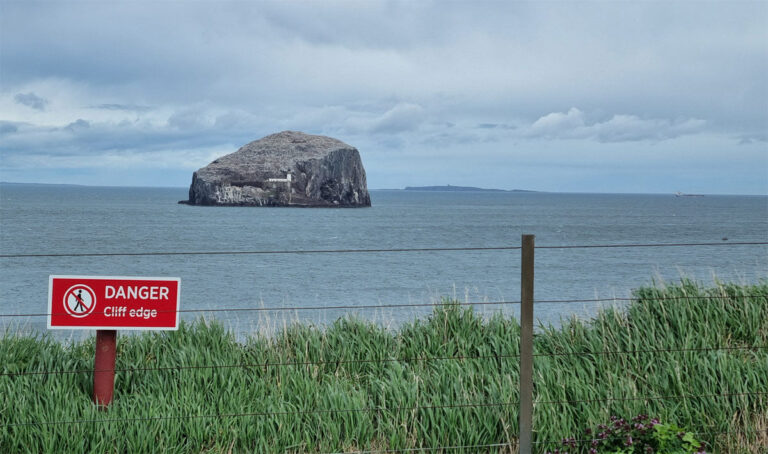
Rising abruptly from the waters of the Firth of Forth, the Bass Rock is one of Scotland’s most arresting coastal landmarks. Sitting just a couple of kilometres offshore from East Lothian and within easy sight of North Berwick, this sheer-sided island appears less like a natural outcrop and more like a fortress shaped by design. At 107 metres high, its pale, bird-covered slopes catch the light from miles around, drawing the eye from across the Lothians and the shores of Fife.
Yet the Bass Rock is more than a dramatic silhouette. It is a place where geology, wildlife and centuries of human history converge in a way few locations in Britain can match.
A Rock Forged in Fire
The island’s origins lie deep in geological time. Formed during the Carboniferous period, the Bass Rock is a volcanic plug composed of phonolitic trachyte. It represents the hardened core of an ancient volcano, left standing after softer surrounding rock eroded away. The formation was significant enough to attract the attention of James Hutton, one of the founding figures of modern geology, who identified it as an igneous intrusion.
It belongs to a chain of volcanic islands scattered along this stretch of coastline, including Craigleith, Fidra and Eyebroughy. Inland, the same geological story echoes through landmarks such as Arthur’s Seat and Castle Rock, linking the Bass to the wider volcanic landscape of eastern Scotland.
Hermits, Kings and Captives
Long before it became a wildlife sanctuary, the Bass Rock was a place of solitude and strategy. In the 8th century, St Baldred chose the island as a hermitage, living in a cave that would later be marked by a chapel built in his honour. Even today, the ruins of that chapel cling to the rock’s slopes, a reminder of its earliest spiritual associations.
Control of the island later passed to the Lauder family, who held it for nearly 600 years. Their fortress, perched above the only viable landing point, took full advantage of the Bass’s natural defences. The 15th-century historian Hector Boece described it as effectively “unwinnable”, and it is easy to see why. Sheer cliffs drop into the sea on all sides, leaving attackers with few options.
Royal attention followed. James I of Scotland was sheltered here as a child, while James IV of Scotland and James VI of Scotland both visited as guests. At one point, James VI even attempted to purchase the island, though the Lauders refused to sell.
The Bass’s role shifted dramatically in the 17th century. Following Cromwellian invasion of Scotland, it was transformed into a state prison. Covenanters and political prisoners were held in harsh conditions, giving rise to its nickname, “the Patmos of Scotland”. Among those confined here was the preacher Alexander Shields, who described the rock as bleak and isolated, dependent on supplies brought from the mainland.
Siege and Survival
The island’s defences were tested during the upheavals that followed the Glorious Revolution. In 1691, a small group of Jacobite prisoners seized control of the castle in a surprise coup, turning their place of confinement into a stronghold.
For three years, they held out against government forces loyal to William III of England. Warships attempted bombardment, but the cliffs rendered such efforts ineffective. A naval blockade tightened the noose, yet the defenders were secretly resupplied from the mainland and even from France.
Only in 1694, with their numbers dwindling and the wider Jacobite cause faltering, did they negotiate surrender. Their resistance remains one of the more unusual episodes in Scottish military history, a prison turned fortress that briefly defied a kingdom.
Soon after, the Bass was abandoned as a military site. In 1706 it was acquired by Hew Dalrymple, beginning a line of ownership that continues today.
A Kingdom of Birds
If history defines the Bass Rock’s past, wildlife defines its present. The island is home to the largest colony of northern gannets on Earth, with more than 150,000 birds crowding its ledges. From a distance, the rock appears white, a result of both plumage and the accumulation of guano.
The species takes its scientific name, Morus bassanus, directly from the island. Known locally as the “solan goose”, the gannet has long been part of the area’s identity, once harvested for food in significant numbers.
The Bass now sits within a protected area recognising its global ecological importance. Other seabirds, including puffins, guillemots and razorbills, share the space, though it is the gannets that dominate both visually and audibly. On calm days, the sound of the colony carries across the water, a constant, echoing presence.
The modern gateway to this spectacle is the Scottish Seabird Centre, which operates remote cameras on the island and runs boat trips that bring visitors close to its cliffs. The experience is immersive, with the scale of the colony only fully apparent at sea level.
That abundance has not been without threat. In 2022, avian influenza swept through the colony, killing thousands of birds in a short period. The sight, described by conservationists as “heartbreaking”, was a stark reminder of how vulnerable even the most established ecosystems can be.
Echoes in Literature
The Bass Rock’s stark outline and layered past have long inspired writers. Robert Louis Stevenson, who spent time in nearby North Berwick, drew on the island’s atmosphere in his work. In Catriona, the protagonist finds himself imprisoned on the Bass, while Stevenson himself described it as a single crag “great enough to carve a city from”.
Later authors continued the tradition, using the island as a setting for historical fiction and imaginative storytelling. Its combination of isolation, drama and authenticity makes it a natural stage for tales that blur the line between history and legend.
Visiting the Bass Rock
While no one lives on the island today, it remains accessible to visitors under the right conditions. Boat trips from North Berwick offer close views and, at times, landings, though weather and wildlife protection measures dictate access.
Even from the shore, the Bass Rock commands attention. It is a landmark that rewards both distant observation and close exploration, revealing different aspects of its character depending on how it is approached.
Few places encapsulate so much in such a small footprint. The Bass Rock is at once a geological relic, a historical stronghold and a thriving wildlife sanctuary, its presence as enduring as the forces that created it.