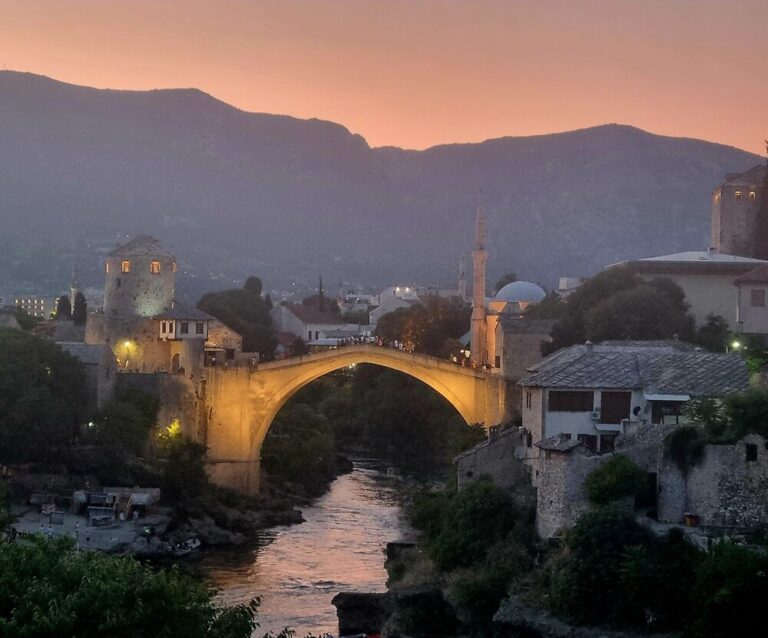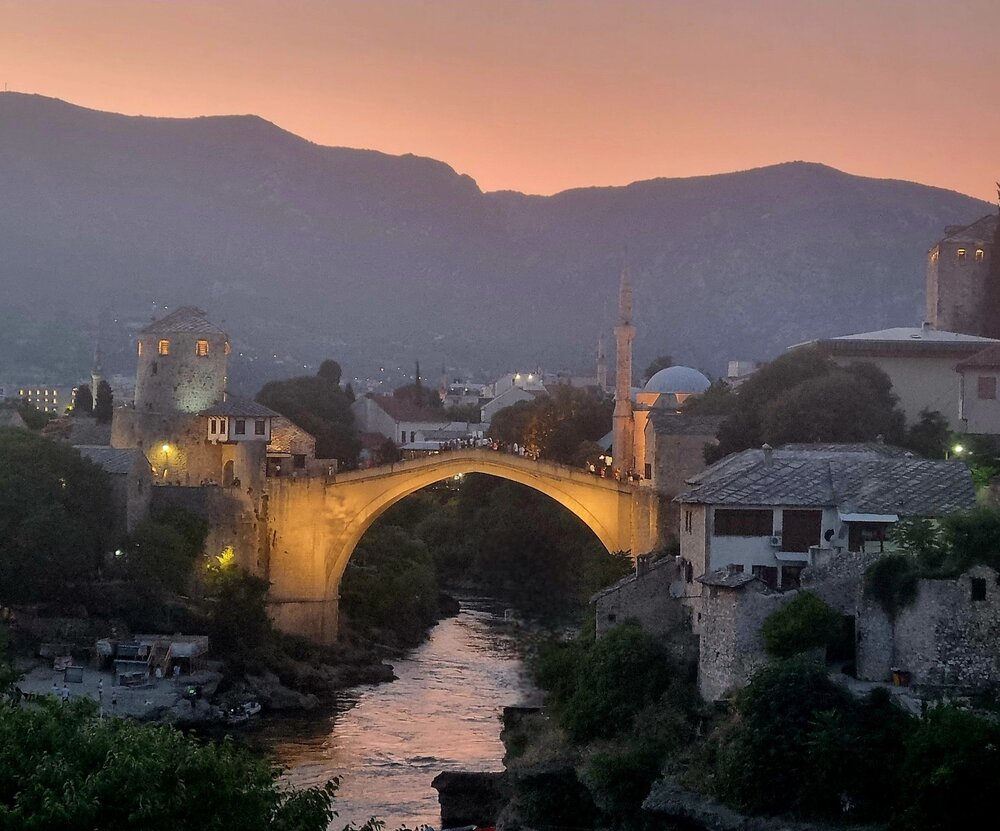
Mostar, a city in southern Bosnia and Herzegovina, sits on the banks of the Neretva River and is known for its mix of Ottoman and European influences. It developed as a regional centre under Ottoman rule and remains best known today for its iconic bridge, Stari Most, which has come to symbolise both the city’s past divisions and its ongoing recovery.
Founded in the 15th century, Mostar grew under the Ottomans as a trading post and administrative hub. Its name comes from the word “mostari”, meaning bridge keepers, referring to those who guarded the original wooden crossings over the Neretva. In 1566, the Ottomans replaced these with a single stone arch, Stari Most, designed by the architect Mimar Hayruddin. At the time, it was considered an engineering achievement, with its elegant curve connecting the two sides of the city. Surrounding the bridge, narrow streets filled with workshops and market stalls took shape, many of which survive today in the Old Bazaar, Kujundžiluk.
In the late 19th century, Mostar became part of the Austro-Hungarian Empire. New administrative buildings, schools and roads were added, creating a contrasting architectural style alongside the Ottoman-era mosques, bathhouses and houses. This layered appearance is still evident, with cobbled lanes giving way to wider streets and European facades.
Conflict and the Fall of Stari Most
The 20th century brought major upheavals. Mostar became part of Yugoslavia after the First World War and later experienced significant industrial growth under the socialist government. Like Sarajevo, it enjoyed a cultural revival in this period, with new institutions and infrastructure.
The 1990s marked a turning point. During the Bosnian War, Mostar suffered heavy damage and a deepening of ethnic divisions. In November 1993, Stari Most was destroyed after centuries of standing, its collapse captured on film and broadcast around the world. The loss of the bridge was both physical and symbolic, cutting off a link between communities.
After the war, extensive reconstruction began. Stari Most was rebuilt using traditional techniques and reopened in 2004. It was later recognised as a UNESCO World Heritage Site, a testament to the city’s resilience and the efforts to preserve its heritage. Today, locals and visitors gather to watch divers jump from the bridge into the river below, continuing a tradition that dates back generations.
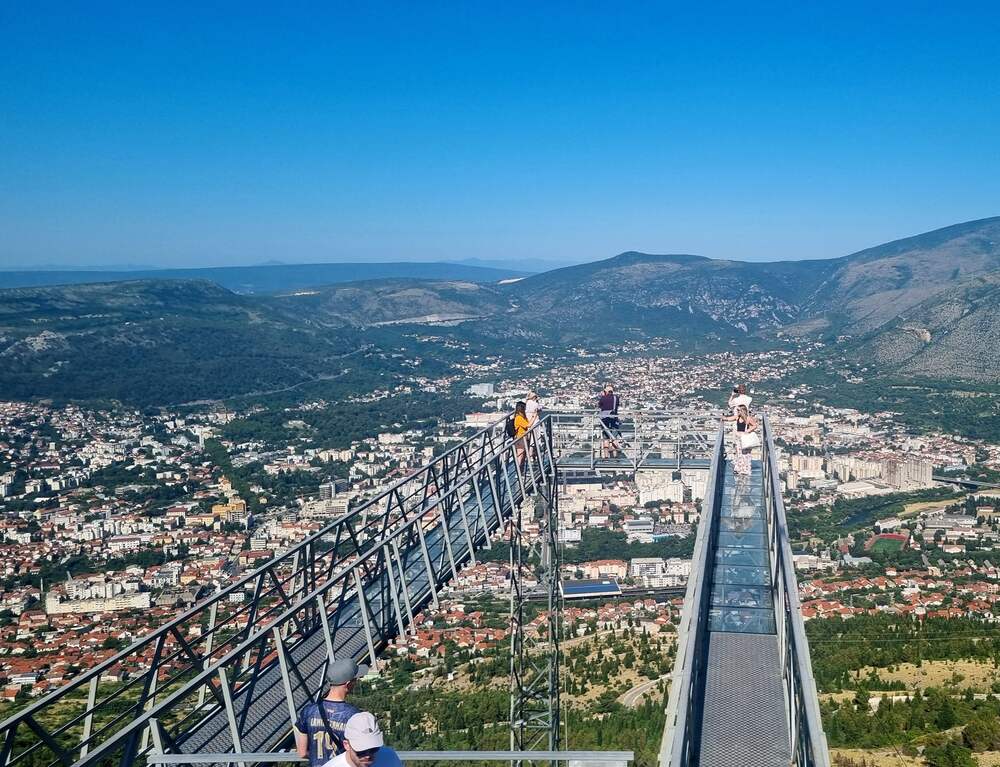
Modern Mostar is a city still coming to terms with its past while attracting travellers and day-trippers drawn to its history and beauty. The Old Bazaar is filled with small shops selling copperware, textiles and souvenirs. Beyond the centre, the surrounding hills offer views of the river valley and reminders of the recent conflict in the form of damaged buildings and memorials.