In 1994, the last Allied troops departed from Berlin, marking the end of an era that had divided the city for decades. Amidst this historical transition, artist Frank Thiel captured a poignant moment in time, now immortalised in his light box installation at Checkpoint Charlie.
Introduction to Thiel’s Light Box Installation
Frank Thiel’s light box installation at Checkpoint Charlie stands as a significant artistic endeavour, blending history with contemporary art. Erected in 1998, the installation features two larger-than-life portraits of soldiers, symbolising the enduring legacy of the Allied forces in Berlin. This installation has become a focal point for both Berliners and tourists, offering a visual narrative of the city’s Cold War past.
The installation is strategically placed at Checkpoint Charlie, a site synonymous with the division of Berlin. Thiel’s work serves as a reminder of the military presence that once dominated the cityscape. By showcasing the faces of soldiers, it humanises the historical narrative, providing a personal connection to an era often characterised by political and military tension.
Historical Significance of Checkpoint Charlie
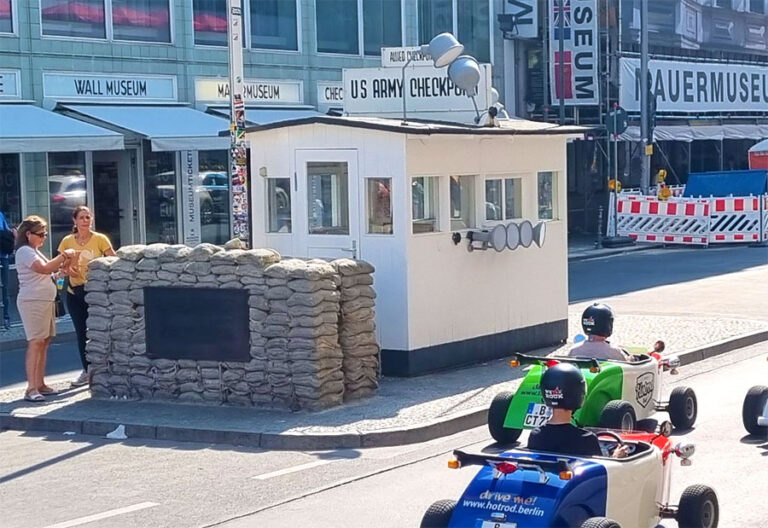
Checkpoint Charlie was one of the most famous crossing points between East and West Berlin during the Cold War. Established in 1961, it quickly became a symbol of the ideological divide between the Soviet-controlled East and the Western Allies. The checkpoint witnessed numerous escapes, confrontations, and diplomatic incidents, making it a hotspot for Cold War tensions.
The location of Checkpoint Charlie at the junction of Friedrichstraße and Zimmerstraße was strategic, serving as a critical passage for diplomats, journalists, and non-German citizens. It was also the site of the infamous tank standoff between Soviet and American forces in October 1961, which brought the world to the brink of a nuclear conflict. Today, the site serves as a poignant reminder of the city’s divided past.
The 1961 Tank Confrontation Revisited
The tank confrontation at Checkpoint Charlie in 1961 was a defining moment in Cold War history. On October 27, Soviet and American tanks faced off at the checkpoint, escalating tensions to a dangerous level. The standoff lasted for 16 hours, with both sides prepared for potential conflict. Fortunately, diplomatic negotiations prevailed, and the tanks were withdrawn without incident.
This confrontation underscored the precarious nature of international relations during the Cold War. It highlighted the potential for small incidents to escalate into major conflicts. The presence of the tanks at Checkpoint Charlie became a powerful symbol of the geopolitical tension that characterised the era.
The Artistic Vision of Frank Thiel
Frank Thiel, a photographer and artist born in Kleinmachnow, Germany, has a keen interest in capturing moments of historical transition. His work often explores themes of identity, memory, and the passage of time. The light box installation at Checkpoint Charlie is a testament to his ability to blend art with historical narrative.
Thiel’s vision for the installation was to create a visual representation of the sector signs that once marked the border between East and West Berlin. By choosing to depict soldiers from the Allied forces, he aimed to provide a human face to the military presence in the city. His work invites viewers to reflect on the personal stories behind the historical events.
A Closer Look at the Light Box Display
The light box installation at Checkpoint Charlie features two portraits, each nearly six meters high. The images depict young soldiers from the respective protecting powers in 1994. Facing east, an American soldier is prominently displayed, while a Soviet soldier, dressed in the uniform of the Russian Federation, faces the former West Berlin.
The choice of these two soldiers serves as a reminder of the four-power status of Berlin during the Cold War. The installation is not intended to depict everyday life at Checkpoint Charlie but rather to evoke the broader historical context of the city’s division. The juxtaposition of the two portraits invites viewers to consider the complex interplay of power and identity during this period.
The Dual Portraits: American and Soviet Soldiers
The portraits in Thiel’s installation are not just artistic representations; they are historical documents capturing the faces of young soldiers at a pivotal moment in history. The American soldier, Jeffrey Harper, was part of the 298th Army Band, stationed in Berlin until the Allied withdrawal in 1994. The identity of the Soviet soldier remains unknown, adding an element of mystery to the installation.
These portraits serve as a visual dialogue between the two superpowers that once dominated Berlin. By presenting the soldiers in their uniforms, Thiel highlights the military presence that was an integral part of the city’s history. The installation encourages viewers to reflect on the human stories behind the geopolitical tensions.
The Role of Allied Troops in Berlin’s History
The presence of Allied troops in Berlin was a defining feature of the city’s Cold War history. Following World War II, Berlin was divided into four sectors, each controlled by one of the Allied powers: the United States, the Soviet Union, the United Kingdom, and France. This division was both a physical and ideological barrier, shaping the city’s development for decades.
Allied troops played a critical role in maintaining the balance of power in Berlin. They were not only a military presence but also a symbol of the West’s commitment to the city’s freedom. The withdrawal of these troops in 1994 marked the end of an era, paving the way for Berlin’s reunification and transformation into a unified city.
The 1994 Departure: Capturing a Moment in Time
The departure of Allied troops from Berlin in 1994 was a significant moment in the city’s history. It marked the end of the post-war occupation and the beginning of a new chapter for Berlin. Frank Thiel’s photographs of soldiers captured during this period serve as a poignant reminder of this transition.
Thiel’s decision to document the soldiers before their departure reflects his interest in capturing moments of change. His photographs offer a glimpse into the lives of the young men who served in Berlin, providing a personal perspective on the broader historical narrative. The light box installation at Checkpoint Charlie preserves this moment in time, inviting viewers to reflect on the legacy of the Allied presence in the city.
Jeffrey Harper: The American Soldier’s Story
Jeffrey Harper, the American soldier featured in Thiel’s installation, had a unique journey in Berlin. Arriving in 1989 as a tuba player with the 298th Army Band, he was part of the cultural and military fabric of the city. Although he never served at Checkpoint Charlie, his image now stands as a symbol of the American presence in Berlin.
Harper first learned of his involvement in the installation during a visit to Berlin in 1999. His story adds a personal dimension to the installation, highlighting the individual experiences behind the historical events. Both Harper and Thiel have expressed a desire for a more authentic representation of the site’s history, cautioning against its commercialisation.

Preserving History: Challenges and Future Plans
Preserving the historical significance of Checkpoint Charlie presents both challenges and opportunities. As a site of immense historical importance, it attracts numerous visitors each year. However, the commercialisation of the area has raised concerns about the integrity of its historical narrative.
Efforts are underway to further develop Checkpoint Charlie as a place of remembrance. Historians, the state of Berlin, and various initiatives are working to ensure that the site’s history is accessible and engaging for everyone. The goal is to create a space where visitors can connect with the past and gain a deeper understanding of Berlin’s divided history.